Bamboo salt (jugyeom)
Korean sea salt packed in bamboo and roasted up to nine times, until it melts into a dark, rock-like mass.
죽염 (jugyeom)
At a glance
| Origin | South Korea |
|---|---|
| Type | Specialty salt |
| How it's made | West-coast sea salt is packed into thick bamboo stems, sealed with yellow clay, and roasted in a pine-wood fire at about 800 °C for 12–14 hours. The salt is ground, repacked and roasted again, up to nine times; the final firing above 1,000 °C melts it. |
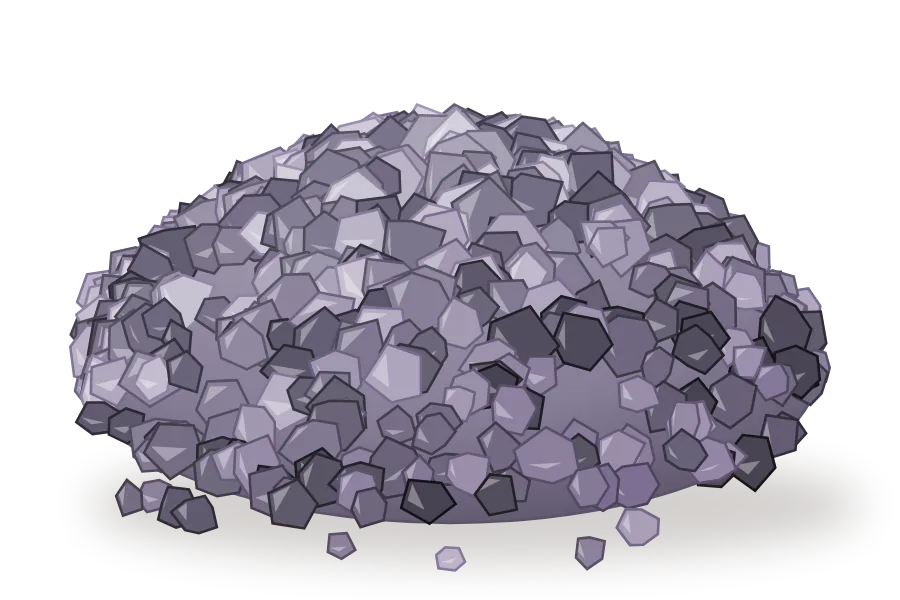
| Colour and texture | Grey to dark, with blue, yellow, red, white and black crystals; the most prized is “purple bamboo salt.” |
| Best for | Seasoning, and in Korea also toothpaste and soap. |
| Swap with | Sea salt, though it will lack the roasted flavour. |
| Health claims | It is used in Korean folk medicine, but it is still 85–98% sodium chloride. |
The story
Bamboo salt was traditionally roasted two or three times; the nine-times method was developed in the 20th century. The bamboo burns away during roasting, leaving a column of salt that has picked up a distinctive flavour Koreans call gamrojung.
What the labels claim
These health claims appear on packaging and in wellness media. We include them so you can recognise them; none is supported by good evidence.
Salt words on this page
Similar salts
 Japan · Specialty saltMoshio (seaweed salt)seaweed saltBest for Rice and vegetables
 India and South Asia · Specialty saltKala namak (Indian black salt)kiln-fired, eggyBest for Chaat, raita, tofu scramble
 Philippines · Specialty saltAsin tibuok (“dinosaur egg” salt)the dinosaur eggBest for Grated over hot rice
Cite this page
For school projects and reports. Teachers often prefer the original sources too: see the list below.
The Salt Almanac. (2026, November 8). Bamboo salt (jugyeom). https://saltalmanac.com/salts/bamboo-salt
“Bamboo salt (jugyeom) | Salts of the World.” The Salt Almanac, 8 Nov. 2026, saltalmanac.com/salts/bamboo-salt. Accessed [today's date].
“Bamboo salt (jugyeom) | Salts of the World.” The Salt Almanac. Last modified November 8, 2026. https://saltalmanac.com/salts/bamboo-salt.
Original sources
- Wikipedia. Bamboo salt. https://en.wikipedia.org/wiki/Bamboo_salt